




Watch the Intro
Simple and Affordable
Find out which works best for you!
Basic
$15-20
per student, per semester
Give a student access to a single course.
Premium
$40
per student, per semester
Give a student access to a single course.
Live Polling + GILGA
$20
per student, per semester
Textbook agnostic allows you to use Lrnr’s GILGA without changing adoptions.
Coming Soon
See Detailed Comparison
Basic
Premium
Live Polling + GILGA
Access to all OpenStax Courseware
Access to all Lrnr Courseware
Course Customization
Interactive Textbook
Adaptive Quizzes
Personalized Assignment Creation
Classroom Engagement with Live Polling
Active Classroom with GILGA
Access to exclusive GILGA Activities
Quiz Banks for all Topics
Single Sign-on with your LMS
6 days a week Customer Support
Free 2-week Trial
Tailored Tools for Your Classroom (OER) Needs
- Personalized Homework
- Interactive Textbook
- Course Customization
- Active Classroom
Explore 0ur Lab Simulations
These are simulations we offer. Based on your preference, we can add it to your course.

Photosynthesis
This simulation helps you to understand oxygen production under different types of light.

Mitosis
Different mitotic stages are studied through microscopic observations.

Respiratory Volumes and Capacities
This test helps you to calculate respiratory parameters (ERV, RV, FRC, and TLC) for a given graphical data.

Meiosis
Different meiotic stages are studied through microscopic observations.

ABO Blood Grouping
This experiment is a qualitative test to detect the presence of antigens (A and B) and determine the Rh factor.

White Blood Cells (WBCs)
This test involves microscopic observation of a blood sample to determine different types of white blood cells (WBCs).

Mendelian Genetics
Virtually simulated breeding experiments are evaluated for genotypes and phenotypes through the monohybrid and dihybrid cross.

Blood Pressure
Here, the systolic and diastolic pressure is determined from the blood pressure monitoring process using a sphygmomanometer.

Bioinformatics
This experiment utilizes the genetic code to determine the mRNA and DNA sequence from a given polypeptide chain.

Serial Dilution
A concentrated bacterial sample is serially diluted to make bacterial counting manageable. Bacterial counts of different dilutions are evaluated.

Streak plate
This experiment helps you perform continuous, quadrant, radiant, or T streaking and assess bacterial growth levels at different streak areas.

Carbohydrate Fermentation
This virtual experiment helps assess whether bacteria ferment glucose and produce gas.

Sulfide-Indole-Motility (SIM) test
This test determines three factors: whether bacteria can move, metabolize sulfur-based amino acids, or synthesize the tryptophanase enzyme.

Lysine decarboxylase (LDC) test
This experiment determines whether bacteria undergo fermentation and produce the lysine decarboxylase enzyme.

Phenylalanine Deaminase test
This test detects the bacterial strains that synthesize phenylalanine deaminase. The dark green color change indicates the presence of phenylpyruvic acid.

Benedict Test
This test detects the presence of reducing sugars in a sample. Amylase digestion of starch gives rise to these reducing sugars.
IodineTest
This test detects the presence of starch in an amylase-treated sample. If starch is absent then amylase has broken down starch to produce reducing sugars

BiuretTest
This qualitative test uses Biuret’s reagent to detect the presence of peptide bonds in proteins or peptides but not in amino acids.

Plasmid DNA extraction and Agarose gel electrophoresis
The structure of plasmids extracted from Escherichia coli is studied with the help of restriction mapping.

Hardy-Weinberg
This equilibrium helps us determine a population’s genotypic, phenotypic, and allelic frequency.

Plant Growth and Hormones
Here, the various aspects of a plant’s growth and development under the influence of Auxins, Cytokinins, Ethylene, Gibberellic acid (GA-3), and Abscisic acid are studied.

Gram Staining
This staining test distinguishes gram-positive and gram-negative bacteria based on the components of the bacterial cell wall.

Atomic bonding
This exercise provides a better understanding of chemical bonds and intermolecular forces.

Microscopy
This experiment provides an understanding of how to calibrate various factors of the microscope for a better view of a cell and its components.
Evaluate students with
timed tests.
Create timed Summative assignments to test students’ conceptual knowledge.

Ignite Your Classroom’s Potential Today!
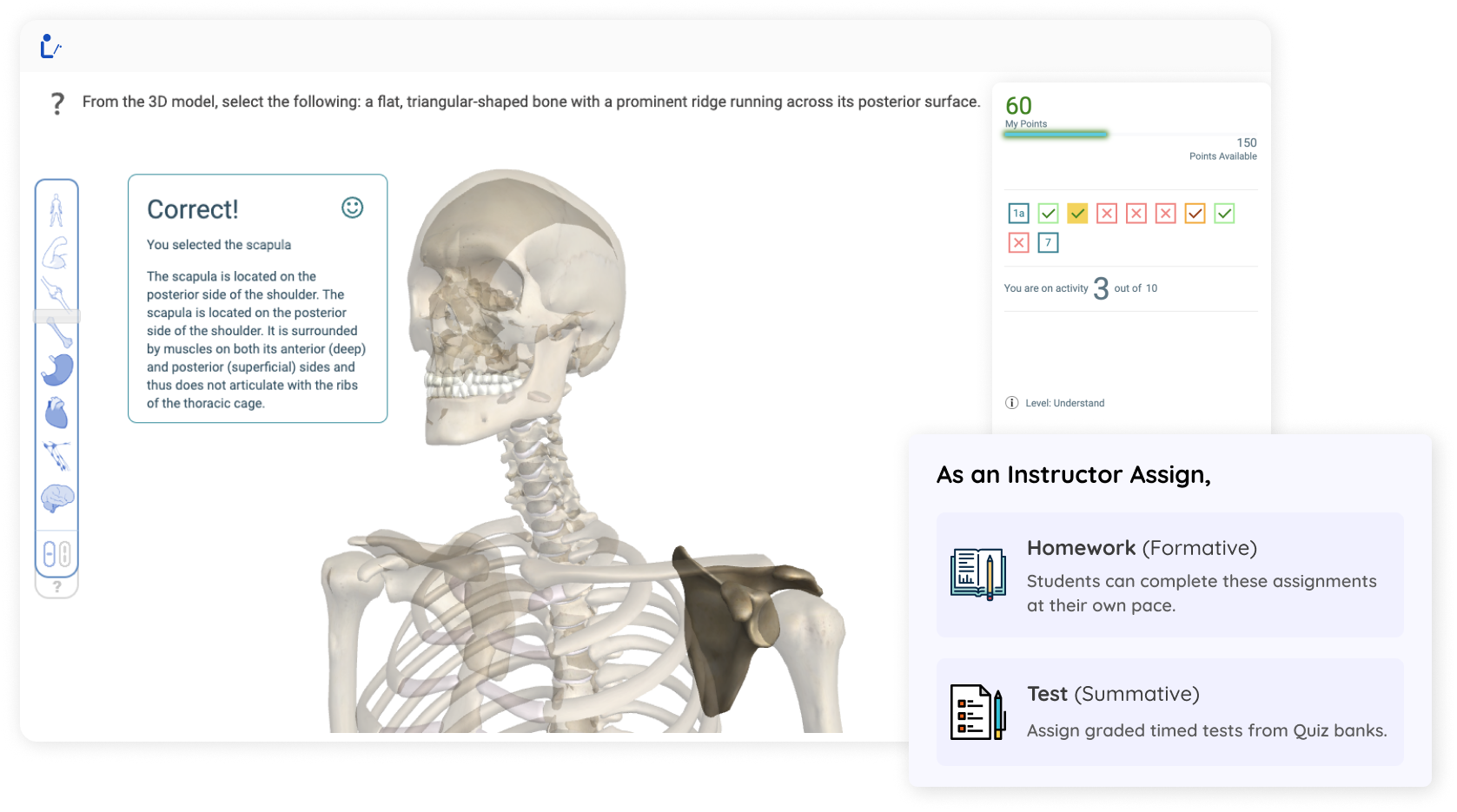
Explore 3D Activities
Immerse into Anatomy & Physiology Labs featuring 3D activities to provide students with a more holistic experience.
Access 3D Models of the Human Anatomy as well!

Unleash Curiosity with Immersive Lab Simulations
Our Lab Simulations allow students to practice real-world techniques, analyze data, and make scientific discoveries.
- Each Lab has multiple storyboards, where no 2 students get the same values.
- Our Labs help in Critical Thinking.

Access Cadavers
Seamlessly switch between Cadaver and 3D Models for a more grounded and realistic view.

Histology Images
Access to over 20+ highly detailed histology images to help provide better learning outcomes for students.

Physical Models at your fingertips!
Physical Models help students easily identify various body parts and aid them in learning better.

Create Annotations and build a Study Guide
Students can use the Annotations tool to create highlights, bookmarks, and notes, reinforcing concepts within the Interactive Textbook.

Liven up your Classroom with Active Learning
Create an Active Learning powerhouse with our Live Polling and Slides. Build student group activities and create a Collaborative Guided Inquiry Environment where your students thrive on learning.

Ignite Your Classroom’s Potential Today!
Dynamic Questions
We ensure that no two students get the same variables and answers. Thereby, increasing the difficulty and improving the variability of questions.

Access to Adaptive Quizzes!
- Adaptive Quizzing challenges every student appropriately while providing the necessary aid to improve cognition and retention.
- Quiz Banks with about 25 questions per chapter section.
- 70% of our questions focus on a higher level of Bloom’s for improved learning.

Interactive Textbook
with Smart Content
An Interactive Textbook with smart content that provides relevant content and activities to aid students in reinforcing concepts.

Create Annotations and build a Study Guide
Students can use the Annotations tool to create highlights, bookmarks, and notes, reinforcing concepts within the Interactive Textbook.

Liven up your Classroom with Active Learning
Create an Active Learning powerhouse with our Live Polling and Slides. Build student group activities and create a Collaborative Guided Inquiry Environment where your students thrive on learning.
